
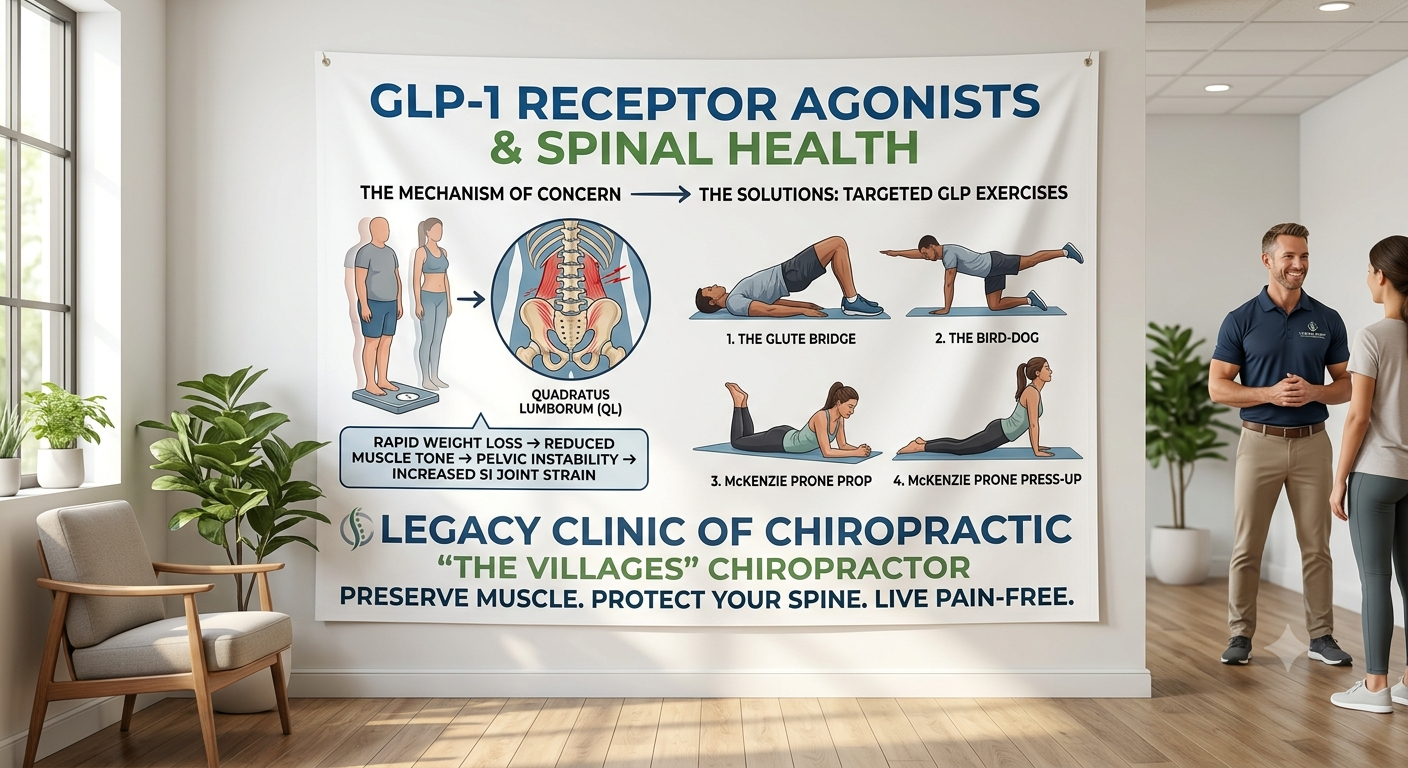
The landscape of wellness and weight loss is shifting rapidly, and right here in Central Florida, we are seeing a massive surge in patients utilizing GLP-1 receptor agonists (like Semaglutide and Tirzepatide). While these medications are incredible tools for metabolic health and weight management, they come with a crucial structural caveat that every patient needs to know.
As a chiropractor in The Villages, I’ve recently noticed a significant uptick in a specific issue: severe sacroiliac (SI) joint pain and lower back instability in patients taking these medications.
If you are on a GLP-1 journey, understanding how these medications affect your musculoskeletal system—and implementing targeted GLP exercises—is essential to staying pain-free and mobile.
The Hidden Cost of Rapid Weight Loss: What GLP-1s Do to Muscle
GLP-1 medications work wonders for appetite suppression and blood sugar regulation. However, rapid weight loss often doesn’t just come from fat store depletion; it can also lead to a noticeable decrease in skeletal muscle mass and overall muscle tone.
When you consume significantly fewer calories, the body can enter a catabolic state, breaking down muscle tissue for energy if it isn’t strictly protected. This rapid drop in muscle tone directly impacts the deep, stabilizing forces of your body—specifically the pelvic stability muscles and the core.
The Structural Collapse: How Supporting Spinal Muscles Deteriorate
Think of your spine as a tall ship’s mast. The bones provide the structure, but a complex system of muscular guy-wires keeps that mast upright against the wind. When GLP-1 medications cause a systemic decrease in muscle tone, those guy-wires slacken.
A primary culprit in this deterioration is the Quadratus Lumborum (QL). The QL is a deep lower back muscle that connects your pelvis to your spine. When the QL and its surrounding neighbors (like the glutes and core) lose their tone, the structural integrity of the lower back diminishes.
Without strong muscular tension, the constant micro-movements of daily life begin to wear directly on your ligaments and joints rather than being absorbed by your muscles.
Why Muscle is Non-Negotiable for Pelvic and Spinal Alignment
Your joints are not built to bear the weight of your body alone. Muscles act as dynamic shock absorbers.
- The Pelvic Bowl: Your pelvis is the foundation of your entire posture. When pelvic stability muscles lose firing power, the pelvis can tilt abnormally.
- The SI Joint Connection: The Sacroiliac (SI) joints connect your spine to your pelvis. When the QL and gluteal muscles weaken, the SI joint loses its muscular “brace.” This leads to hypermobility, friction, and the sharp, localized lower back pain we are increasingly treating at Legacy Clinic.
To prevent this spinal misalignment and joint strain, your fitness routine must shift from purely burning calories to intentionally preserving and building lean muscle tissue.
The Ultimate Defense: GLP Exercises to Protect Your Spine
To combat muscle loss and safeguard your SI joint, your rehabilitation and exercise focus should be two-fold: waking up the posterior chain and maintaining spinal extension.
1. Strengthening the Posterior Chain – The posterior chain refers to all the muscles on the back of your body—from your calves and hamstrings up to your glutes, erector spinae, and QL. Strengthening these muscles forces the pelvis into a stable, neutral position.
The Glute Bridge – This is an exceptional, low-impact way to fire up the glutes and take the pressure off your SI joint.
- How to do it: Lie on your back with your knees bent and feet flat on the floor. Squeeze your glutes and drive through your heels to lift your hips toward the ceiling until your body forms a straight line from shoulders to knees. Hold for 2 seconds, then slowly lower. Aim for 3 sets of 12 repetitions.
The Bird-Dog – This exercise builds cross-body stability, directly engaging the QL and deep spinal stabilizers.
- How to do it: Start on your hands and knees. Simultaneously extend your right arm straight forward and your left leg straight backward. Keep your hips level and squeeze your core. Return to the starting position and switch sides. Do 3 sets of 10 reps per side.
2. Restoring Alignment: McKenzie Exercises – When pelvic muscles weaken, we tend to slouch or overcompensate, pushing our discs and joints into painful positions. McKenzie exercises focus on “extension”—bending backward to relieve pressure on the spinal discs and restore natural curvature.
The Prone Prop (Passive Extension)
- How to do it: Lie flat on your stomach. Slowly prop yourself up onto your elbows, keeping your hips and pelvis completely relaxed and glued to the floor. Breathe deeply and hold this position for 1 to 2 minutes. This gently coaxes the lower lumbar spine back into its proper alignment.
The Prone Press-Up (Advanced Extension)
- How to do it: From your stomach, place your hands flat on the floor under your shoulders (like a push-up position). Keeping your lower body completely relaxed, press through your hands to straighten your arms as much as comfortable, arching your lower back. Only go as far as pain allows, hold for 2 seconds, and lower back down. Repeat 10 times.
Partnering with Your Local Chiropractor
Medication can be a fantastic tool for reaching your health goals, but structural health cannot be neglected in the process. If you are taking a GLP-1 medication, you must actively train to maintain your muscle tone.
If you are experiencing new lower back twinges, hip achiness, or sharp SI joint pain, don’t wait for it to alter your gait. As an experienced chiropractor in The Villages, the team at Legacy Clinic of Chiropractic is here to help you pair your metabolic transformation with a structural one.
We can evaluate your pelvic alignment, ensure your joints are moving properly, and customize a functional movement plan tailored to your journey. Ready to protect your spine while reaching your health goals? Contact Legacy Clinic today to schedule a structural assessment!